Hahei is a small coastal village on the eastern edge of the Coromandel Peninsula, home to around 300 people. The town has no traffic lights, just a single main road and a local store that doubles as a central meeting point.
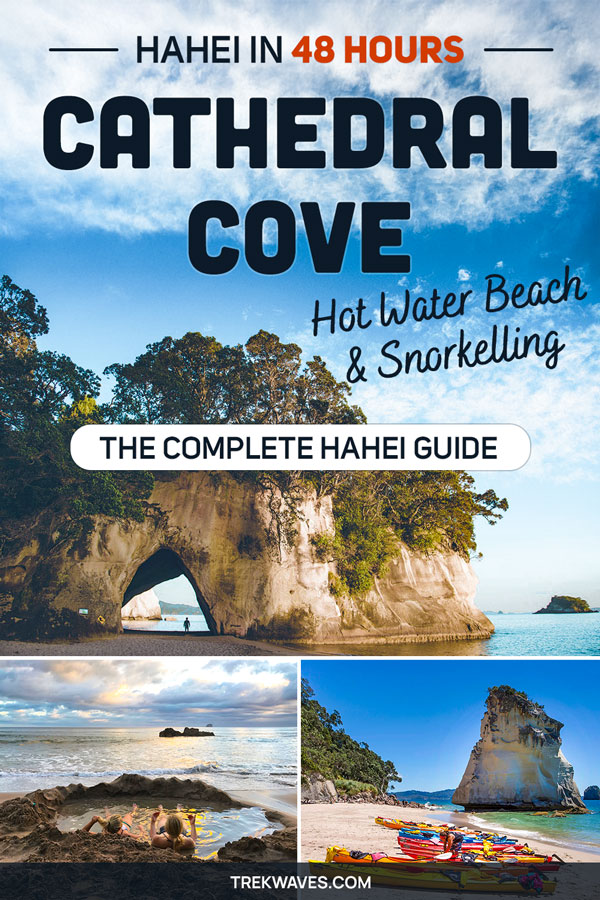
Yet within a few minutes’ drive of this quiet town, you’ll find two of the most iconic coastal landmarks in New Zealand: a geothermal beach where you can dig your own hot pool in the sand, and a cathedral-like sea arch so striking it was used as a filming location in The Chronicles of Narnia.
We spent two days based in Hahei, and it quickly became clear that rushing through doesn’t do this area justice.
For first-time visitors, the biggest keys to planning Hahei properly are choosing the right base, timing Hot Water Beach around low tide, and deciding how you want to reach Cathedral Cove. This guide covers all three in the order we experienced them.
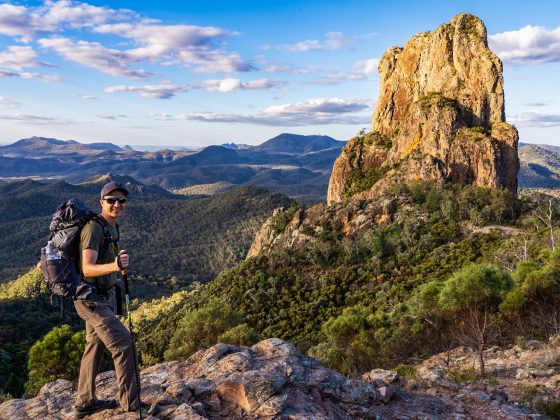
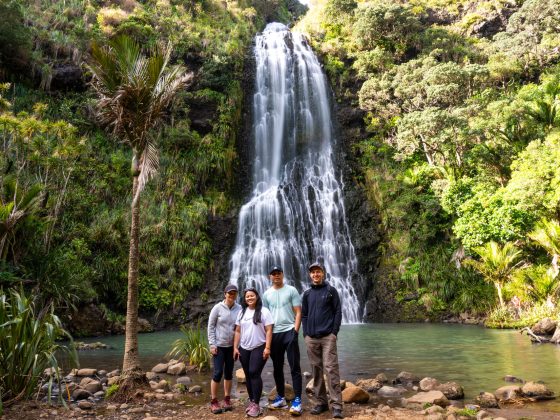
If you’re planning a longer trip to New Zealand, this stop pairs well with some of the best coastal and volcanic walks in my guide to the 25 Best Hikes in North New Zealand.
Where to Stay in Hahei
Choosing where to stay in Hahei makes a bigger difference than it might seem. With Cathedral Cove and Hot Water Beach both requiring a bit of planning — especially around tides and timing — being based close to everything gives you far more flexibility.
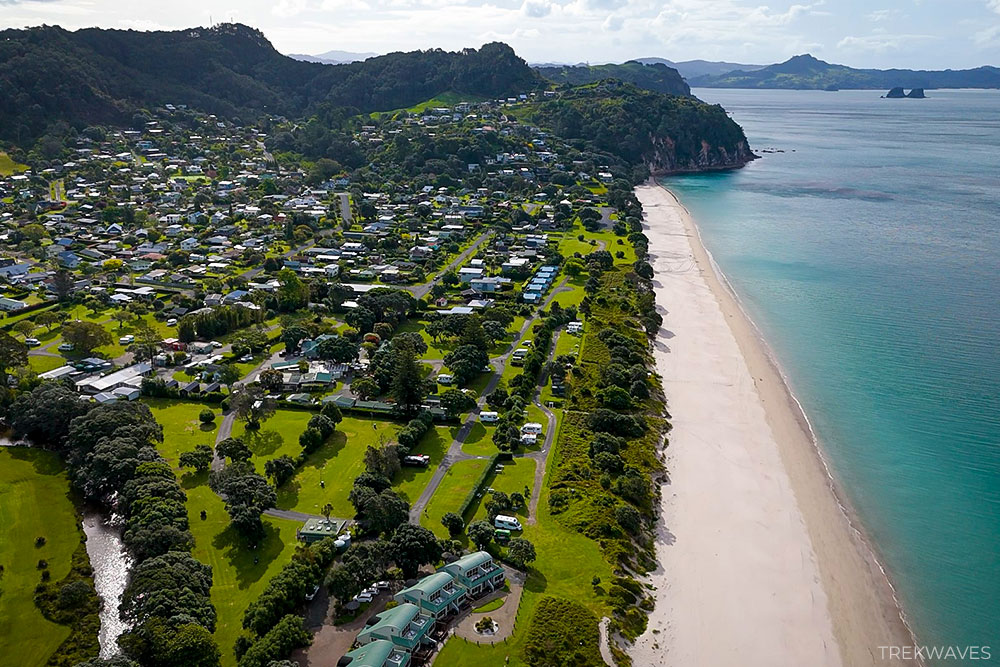
We stayed at Hahei Beach Resort, just a short walk from the shoreline, and it turned out to be the ideal base for exploring the area without constantly needing to drive.
We visited in early November, just before the peak summer season, and arrived midweek — which made a noticeable difference. It meant fewer crowds and a much better chance of getting one of the top beachfront sites, just a few steps from the sand.
If you want to see exactly which site we managed to get — and how it compares to the rest of the park — along with a full walkthrough of all the accommodation areas, check out the video below:
The Grounds & Accommodation Options
The resort spans over 7 hectares, which makes it far larger than it first appears from the road. Once inside, it feels more like a small beachfront village, with different zones spread out across the property and multiple paths leading down to the beach.
There are several accommodation areas to choose from depending on your budget and style:
- Beachfront camping — the best-positioned spots on the property, sitting right along the front just metres from the water.
- Powered & standard campsites (throughout the park) — spread across different sections, including quieter areas further back from the beach.
- Cabins & Studios — classic Kiwi-style units with basic amenities and private space. A step up from camping, suited for couples or small groups.
- Beachfront Baches — modern holiday homes with 3 bedrooms, full kitchens, and outdoor areas, located just behind the dunes.
- Seaview Villas — positioned on the more elevated side of the resort, offering great ocean views along with private balconies, full kitchens, and a more premium, self-contained feel.
- Glamping tents — a newer addition in some sections of the park, offering a more comfortable camping-style experience without needing your own setup.
Food & Drink On-Site
Another thing that makes staying here easy is that you don’t need to go far for food — which is especially helpful in Hahei, where dining options are quite limited and often seasonal.
Across the village, there are only a handful of eating spots — places like The Church Bistro, Eggcentric Cafe, Hahei Beach Cafe, and a few casual takeaway options — many of which operate more consistently during the peak summer months.
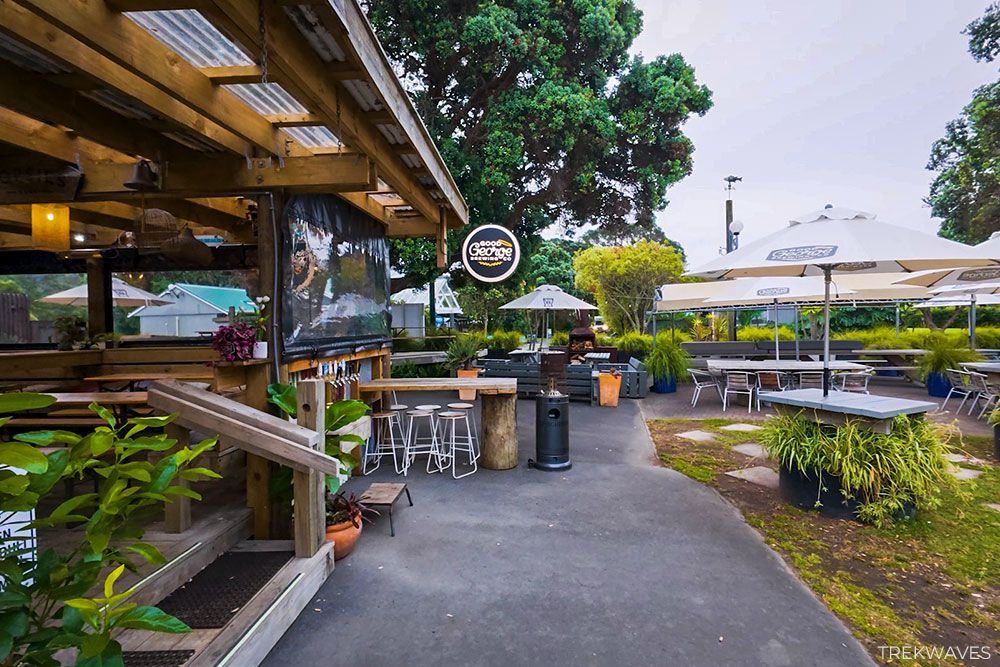
Within the resort, there are 3 go-to spots all located right next to each other:
- BarHei — an outdoor beach bar with good selection of drinks and easy-going vibes
- Woody’s Pizza
- Beach Buns Burgers
That makes Hahei Beach Resort not just a convenient place to sleep, but one of the more practical evening bases in the area.
Shared Facilities
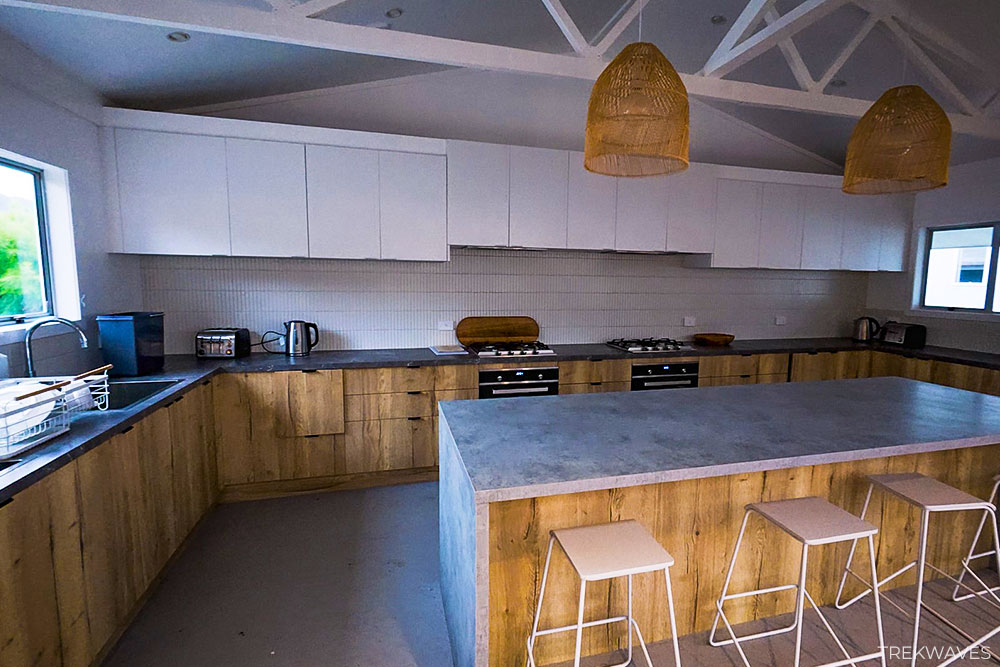
The shared facilities are well-maintained and practical. The main kitchen is fully equipped for self-catering, laundry is on-site, and there are plenty of clean bathrooms and showers.
Cooks Beach & Shakespeare Cliff Lookout
After checking into Hahei Beach Resort, this was the first place we headed — an easy stop that fits nicely into the afternoon.
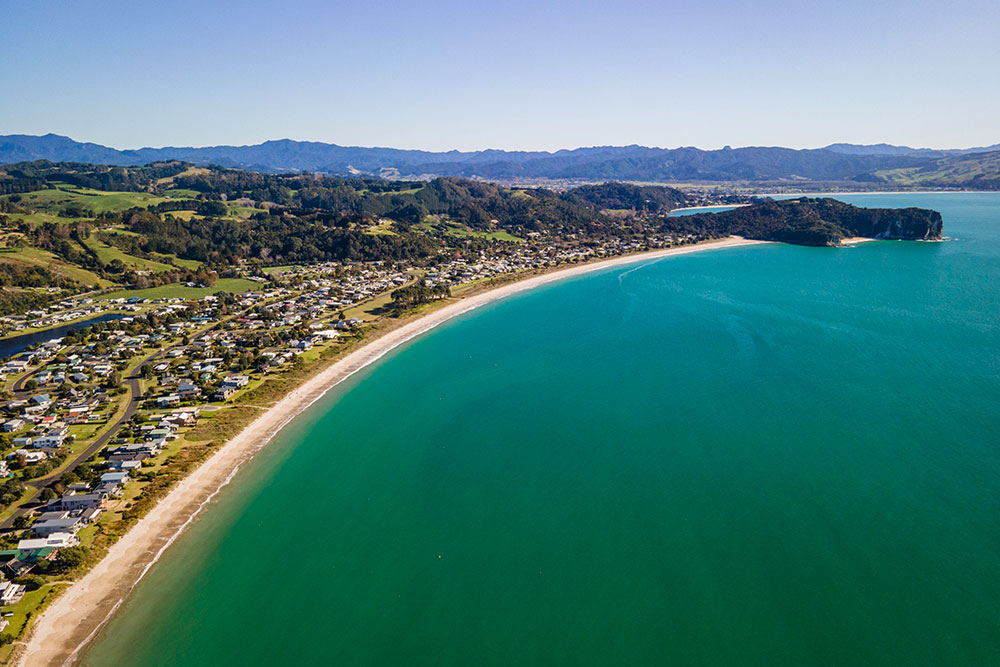
Cooks Beach is only about a 15-minute drive from Hahei but feels noticeably quieter, with a long stretch of sand and a more laid-back, residential vibe.
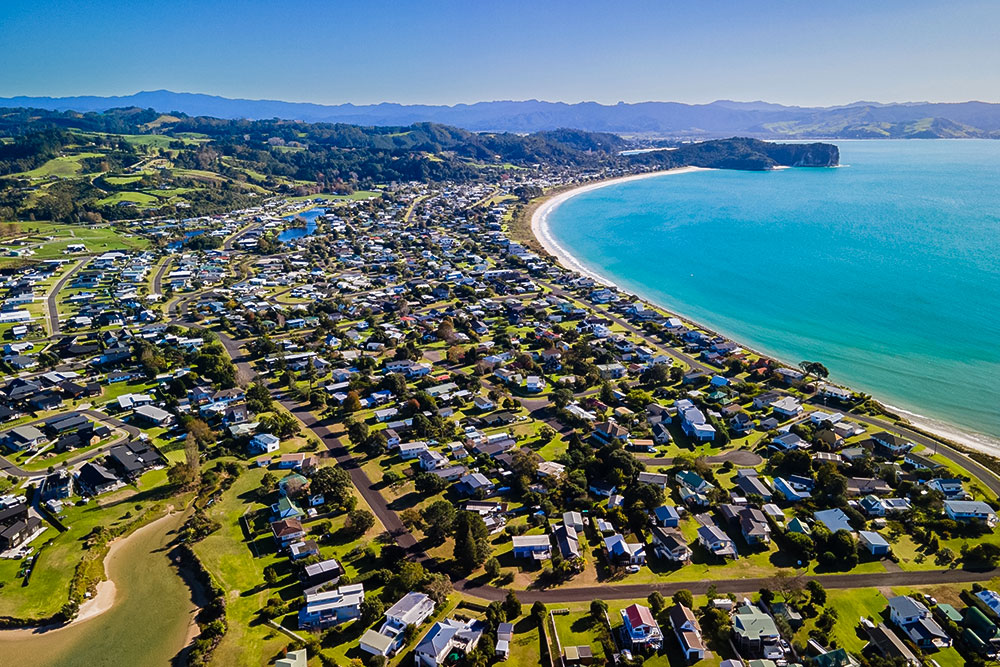
At the far end of the beach, there’s a short loop track (2.7 km) up to Shakespeare Cliff Lookout. It’s an easy walk through coastal forest with a few viewpoints along the way.
Shakespeare Cliff Lookout
The lookout is easily the highlight here, and even if you skip the walk, it’s still well worth the stop.
You can drive almost all the way up, and from the top, the views open out across Cooks Beach and Lonely Bay — one of the best vantage points in the area.
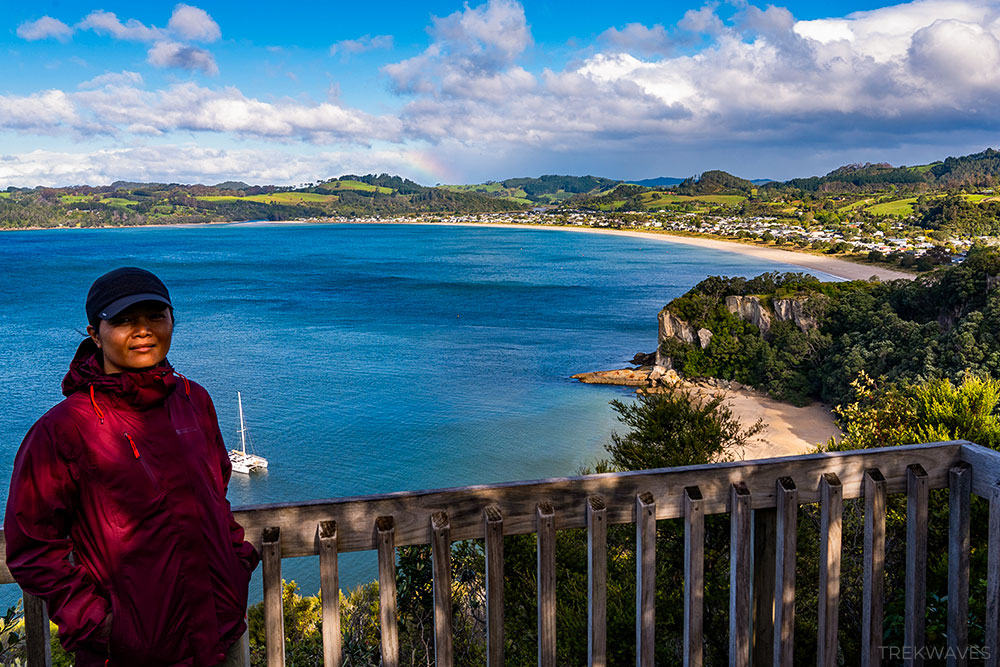
The history here is genuinely fascinating. According to the plaque at the lookout, HMS Endeavour — under the command of Lieutenant James Cook — was anchored in Mercury Bay from 5 to 15 November 1769.
During that stay, Cook came ashore at what is now Cooks Beach to observe the Transit of Mercury across the face of the sun, a rare astronomical event that occurs only around 13 times per century.
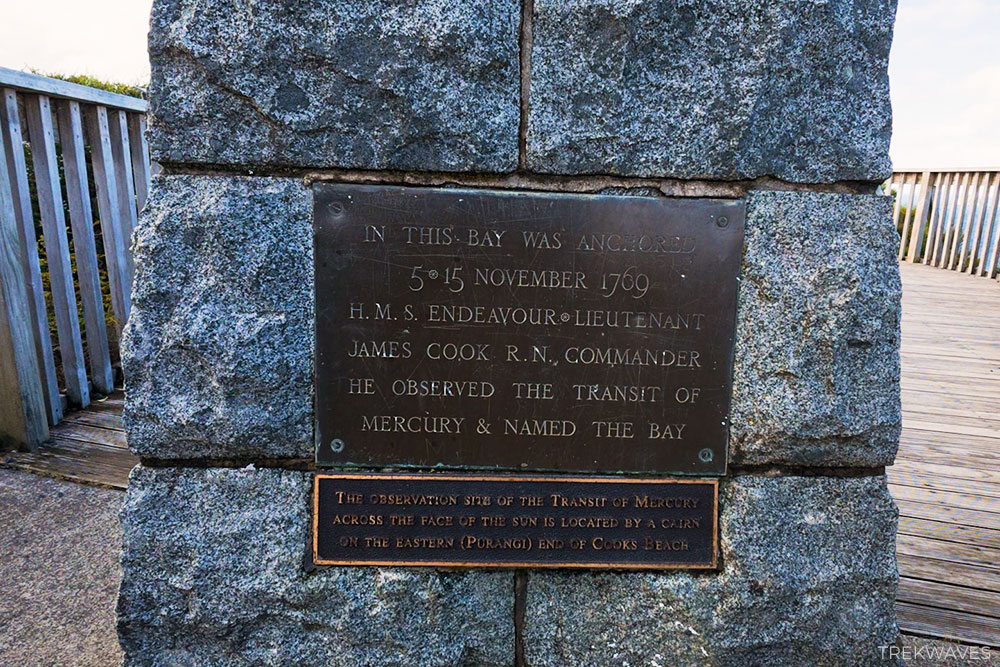
Cook named the bay Mercury Bay in honour of the event — the headland itself, known to the local Ngāti Hei people as Paparoa, was renamed Shakespeare Cliff during this era.
If the weather’s good, it’s worth doing the full loop or heading down to nearby Lonely Bay, but even as a quick stop, this is an easy win.
Cooks Beach as a Base
Cooks Beach is also worth considering as an alternative base.
Cooks Beach Resort has everything from beach chalets and studio cottages to powered campervan sites, and we noticed a few residents along the Marine Parade offering informal campervan parking for a small fee.
The trade-off is a 10–15 minute drive to the Cathedral Cove trailhead rather than walking distance, but for a budget-conscious night on the Coromandel, it makes a lot of sense.
Hot Water Beach: Best Time to Visit, Spade Hire & How It Works
Hot Water Beach is one of those places that sounds overrated on paper. Crowds, people digging holes in the sand — it doesn’t exactly scream must-see.
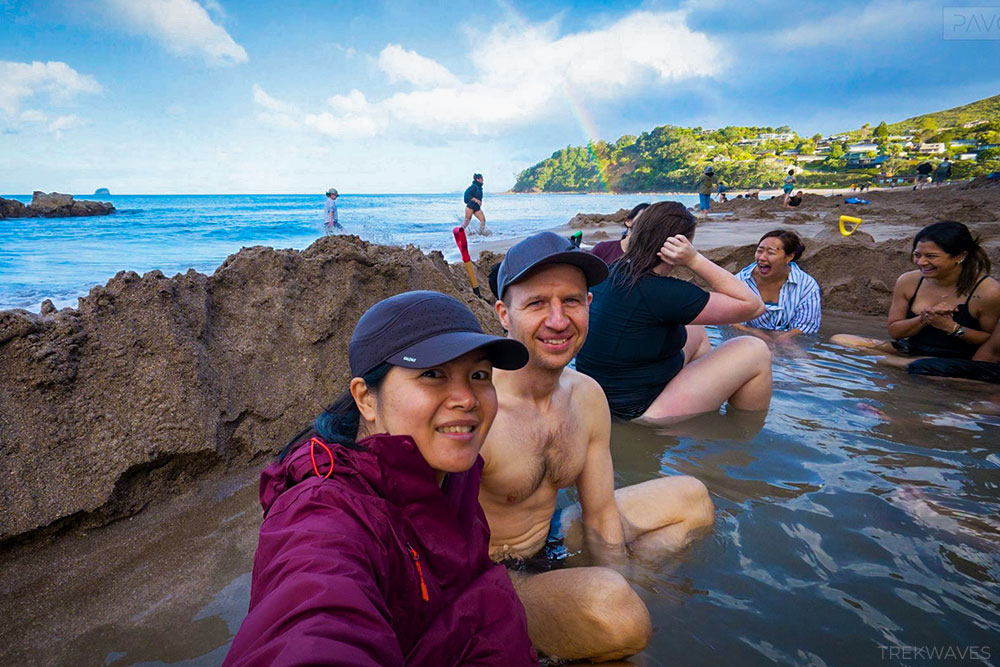
But once you try it, it’s easy to see why it’s so popular. Sitting in a hot pool you’ve dug yourself, right on the edge of the ocean, is an experience unlike anything else.
And when you consider that the heat is coming from geothermal activity deep below the surface, it becomes clear this isn’t just a tourist attraction — it’s a genuinely unique natural phenomenon.
Best Time to Visit
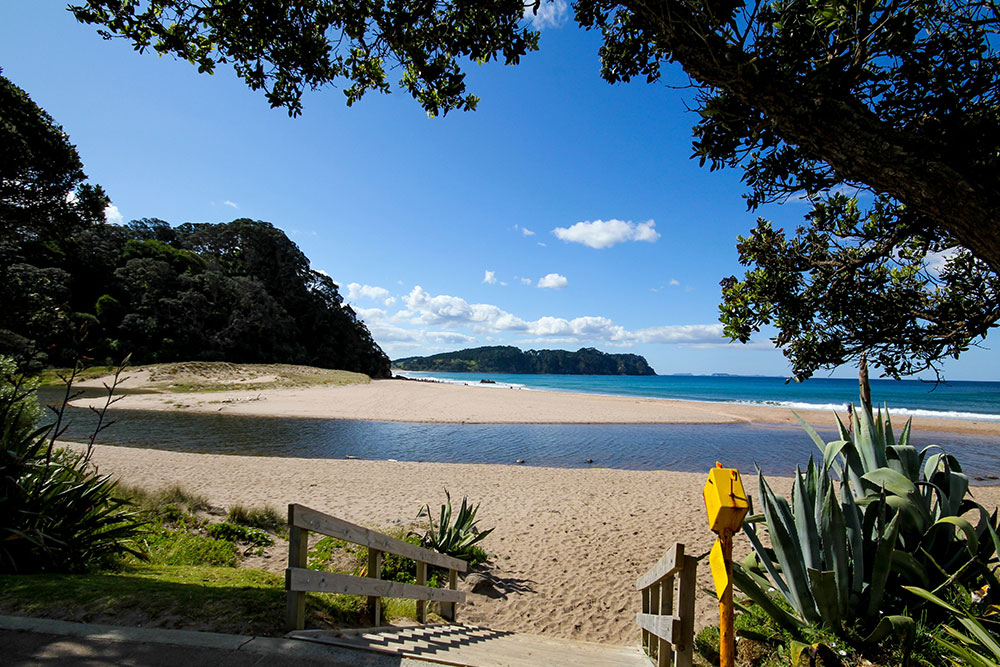
Hot Water Beach only works within two hours either side of low tide — outside of that window, the springs sit under the ocean and there’s nothing to dig.
We visited in the early evening, arriving around 5–6pm, which worked really well for a quieter atmosphere and softer light.
If you can, aim for 1–2 hours before low tide to give yourself enough time before the water comes back in. You can check Hot Water Beach tide times on this website.
Do You Need a Spade?
If you have a shovel, bring it — it makes things much easier.
Spades can usually be hired nearby (often from lifeguards or local shops) for around $10 NZD, but when we visited there was no one around, so we went without one. Instead, we just jumped into one of the pre-dug pools left behind by other people, which worked perfectly fine.
How Hot Water Beach Works
It’s worth understanding what’s happening beneath your feet — because it’s genuinely remarkable.
Deep below the surface, there’s a geothermal system formed by ancient volcanic activity in the Coromandel, dating back roughly 5–9 million years.
Groundwater seeps down through cracks in the rock, gets heated by hot underground formations, and then rises back up through fractures — eventually emerging through the sand on the beach.
At Hot Water Beach, there are two named springs — Māori and Orua:
- Northern spring (Māori) — up to 64°C, flowing at 10–15 litres per minute
- Southern spring (Orua) — up to 60°C, located about 20 metres further south; its bubbling is caused by carbon dioxide gas, not boiling water
That’s why most people dig shallow pools and let cooler seawater mix in — sitting directly on the source would be far too hot.
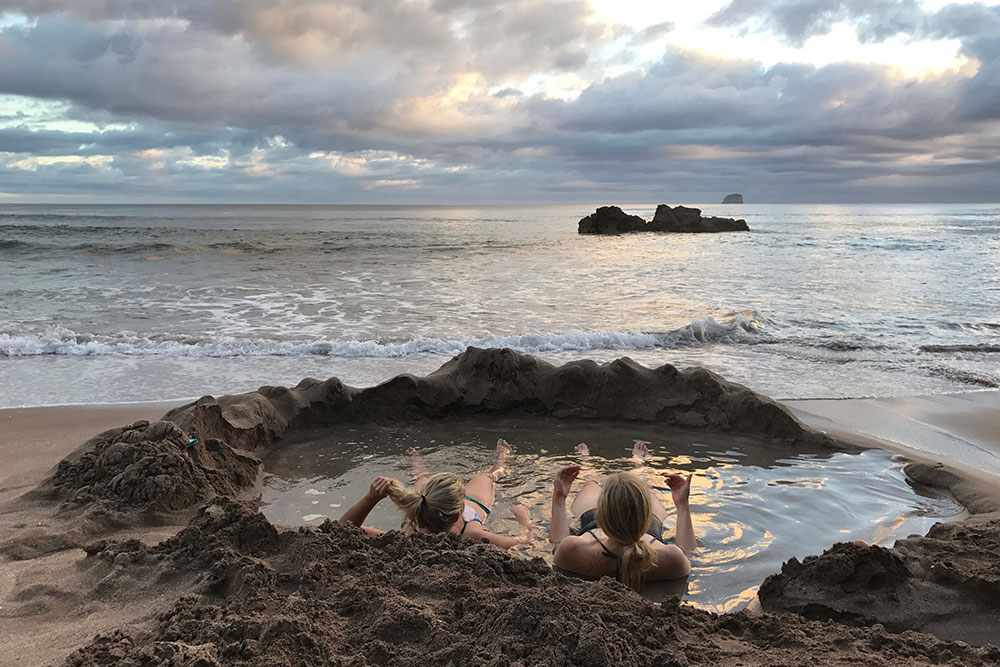
The spring water is chemically neutral — neither acidic nor alkaline — and contains a natural mineral mix of calcium, magnesium, potassium, fluorine, bromine and silica. Essentially a geothermal spa, straight from the earth.
How to Get to Cathedral Cove (Mautohe)
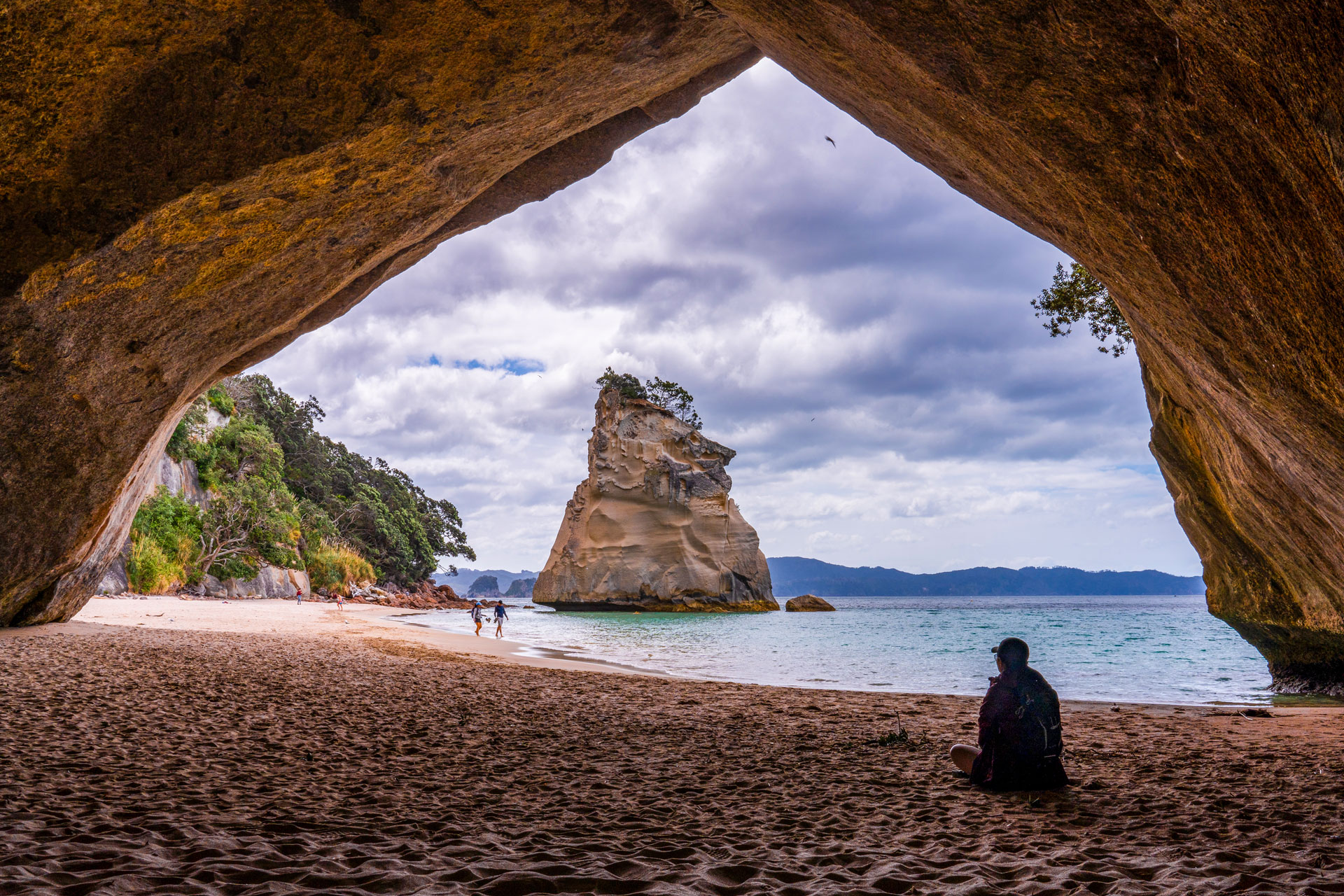
Cathedral Cove is one of the most recognisable spots on the Coromandel — a natural sea arch carved into the cliffs, with clear water, white sand, and views that feel straight out of a film set.
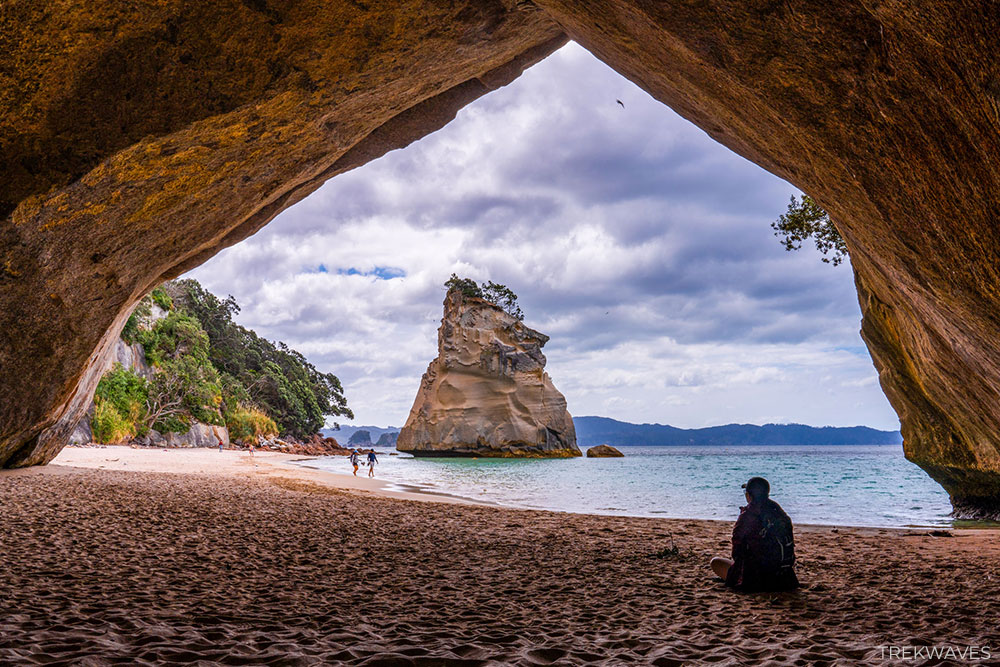
There are a few different ways to get there, and choosing the right one makes a big difference to your experience.
During the summer months, there’s no parking at the Grange Road track entrance, so you’ll need to plan your transport in advance.
Here’s how the options break down:
Option 1: Coastal track from Hahei Beach — best for scenery
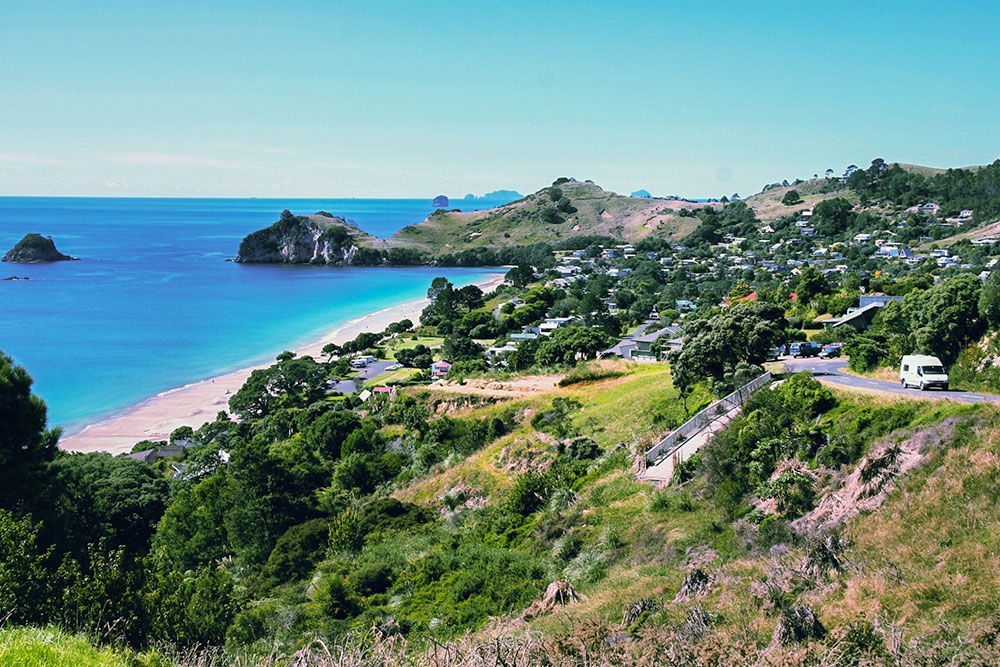
This is the route we took — a scenic coastal path starting from the northern end of Hahei Beach that winds through native bush before linking up with the main Cathedral Cove track.
It’s a more scenic and rewarding way to get there, but the track has been affected by closures since Cyclone Gabrielle in 2023, so it’s worth checking the DOC website before you go.
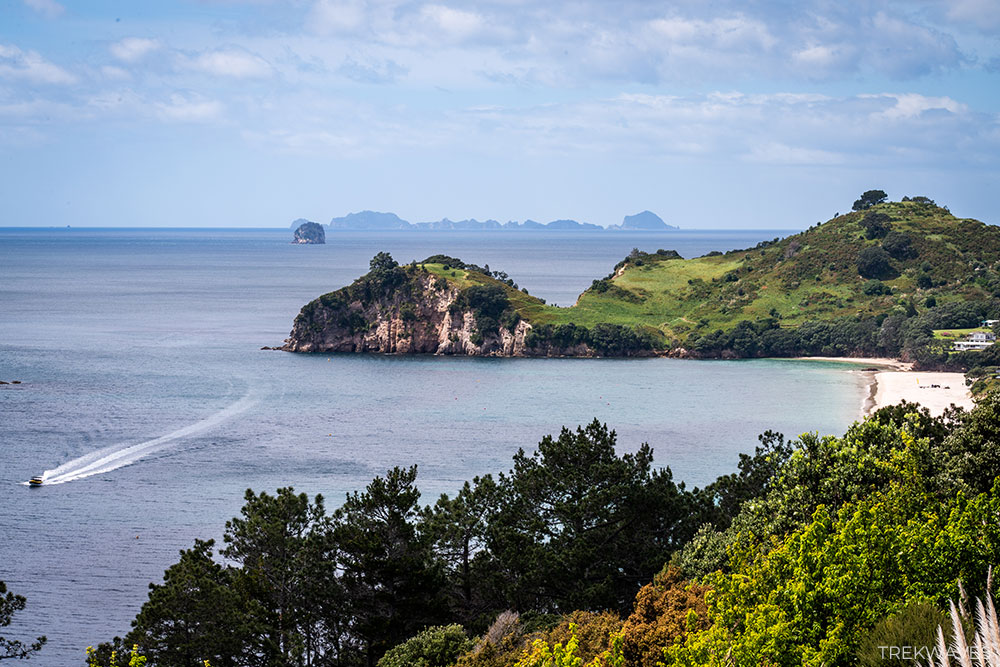
Option 2: Shuttle from Hahei Visitor Car Park — best for convenience
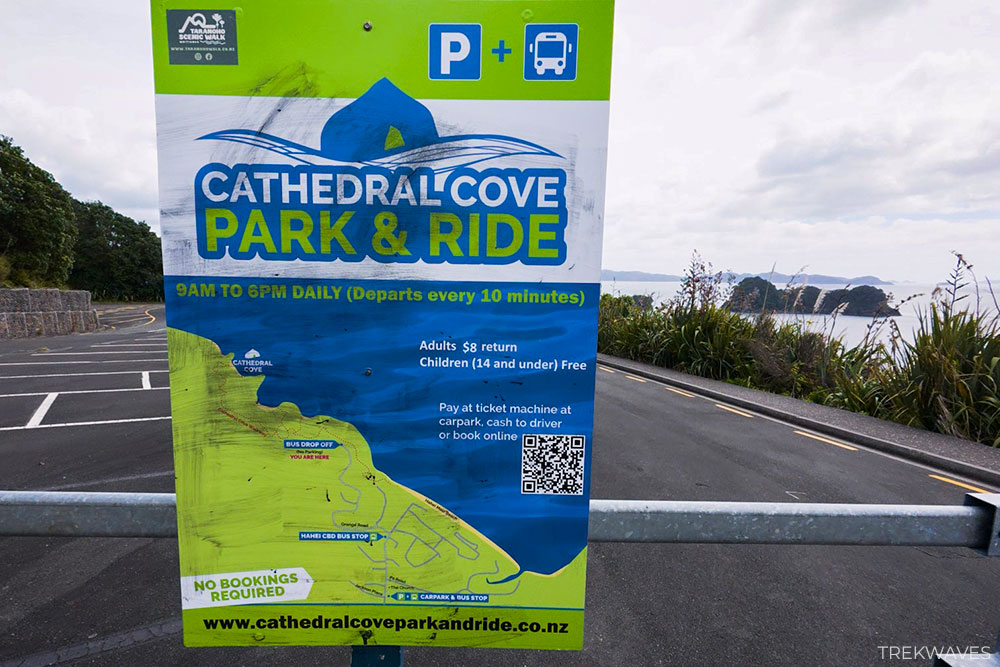
You can park for free at the Hahei Visitor Car Park at the village entrance, then catch the shuttle to the Grange Road track entrance.
It runs every 10–15 minutes from 9am to 6pm, takes about 10 minutes, and drops you right at the trailhead. The most practical option for most visitors, especially families.
It’s worth noting that the shuttle doesn’t start until 9am, so if you’re planning an early start to beat the crowds you’ll need to walk up instead.
Option 3: Grange Road walk — best free option
A free alternative to the shuttle — simply walk from the village up Grange Road to the track entrance.
It’s not glamorous — a steady uphill climb on a road with very little shade, taking around 20–30 minutes each way. But it’s completely free and means you’re not tied to the shuttle timetable, which is handy for very early starts.
Option 4: Private driveway parking along Grange Road
During peak summer months, some residents along Grange Road offer paid parking in their driveways or grassy areas — the benefit being a much shorter walk up the hill to the start of the track compared to coming from the village.
We’ve seen this mentioned at around $10 per car, though availability is informal and not guaranteed.
Option 5: Lees Road Gateway Trail — best for flexibility
Search “Cathedral Cove Gateway Trail” on Google Maps to find it. The $15 per car fee covers everyone in the vehicle and you pay by QR code on arrival.
From the car park a private farm walk connects to the main Cathedral Cove track about halfway down, cutting total walking time to the cove to around 30–40 minutes.
It’s less shaded and less scenic than the Grange Road approach, but it’s quieter, requires no shuttle, and lets you start as early as you like. Note the gate closes at 7pm in summer.
Option 6: Water taxi — best for saving time
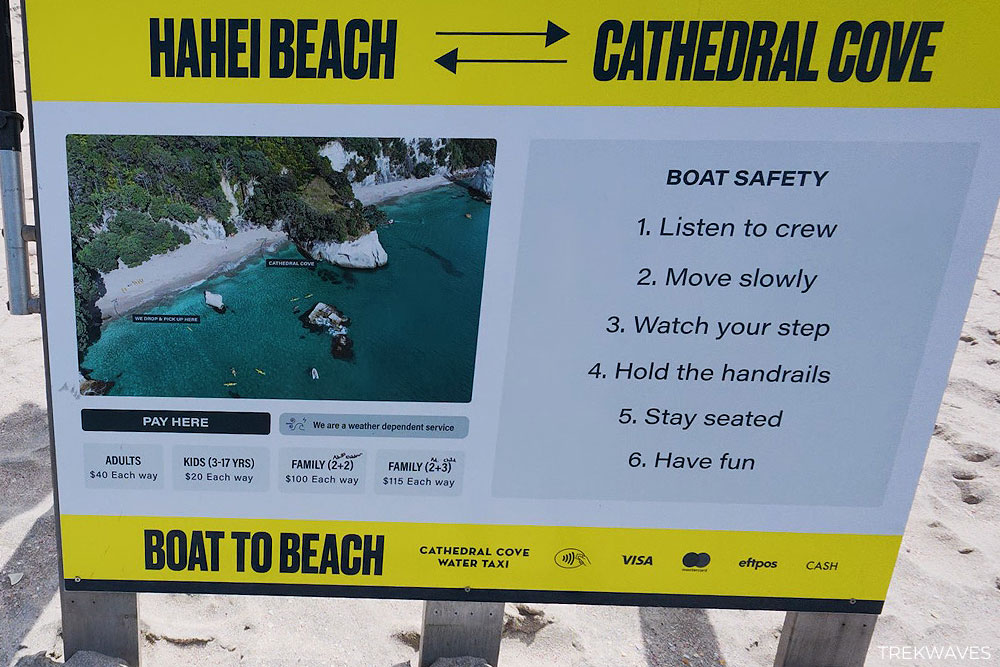
The Cathedral Cove Water Taxi departs every 30 minutes from Hahei Beach — look for the yellow flags — and drops you directly onto the sand at Cathedral Cove.
It costs $40 each way for adults and $20 for children. It skips the walk entirely, which means missing the bush trail and lookouts — but as a one-way return option after you’ve already walked in, it’s a great way to finish the day.
Option 7: Kayak tours from Hahei Beach — best for experience
Another option we saw while staying in Hahei is kayaking to Cathedral Cove — either on a guided tour or (less commonly) independently.
Most visitors go with a guided kayak tour, which departs directly from Hahei Beach and follows the coastline through the marine reserve, passing sea caves, offshore islands, and smaller bays before reaching the Cove.
Tours typically run for around 3 hours and cost roughly $150–$175 NZD per adult, with lower rates for children.
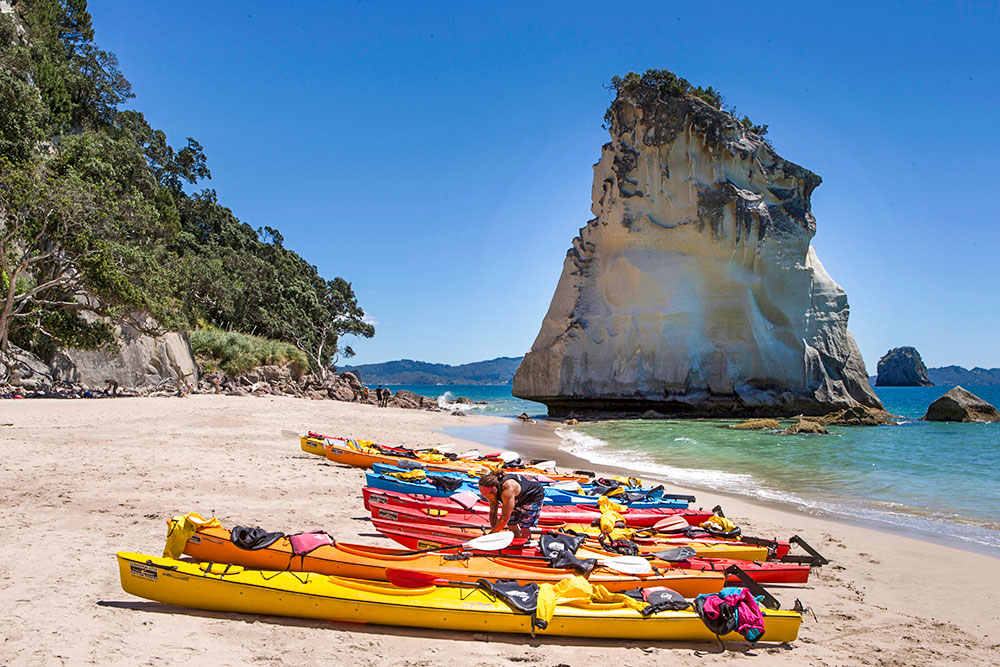
Independent kayak hire is more limited. The coastline here is exposed, and operators generally don’t offer unguided rentals in most conditions due to safety risks.
If the weather is calm, it’s one of the most unique ways to reach Cathedral Cove — but it’s also one of the more expensive and conditions-dependent options.
Cathedral Cove Track Guide: Route, Time & Difficulty
From the Grange Road entrance, the track is approximately 1.8km to the cove — well-maintained, mostly paved, with some steep sections and stairs near the end. Allow around 45 minutes at a comfortable pace, more if you stop at the lookouts.
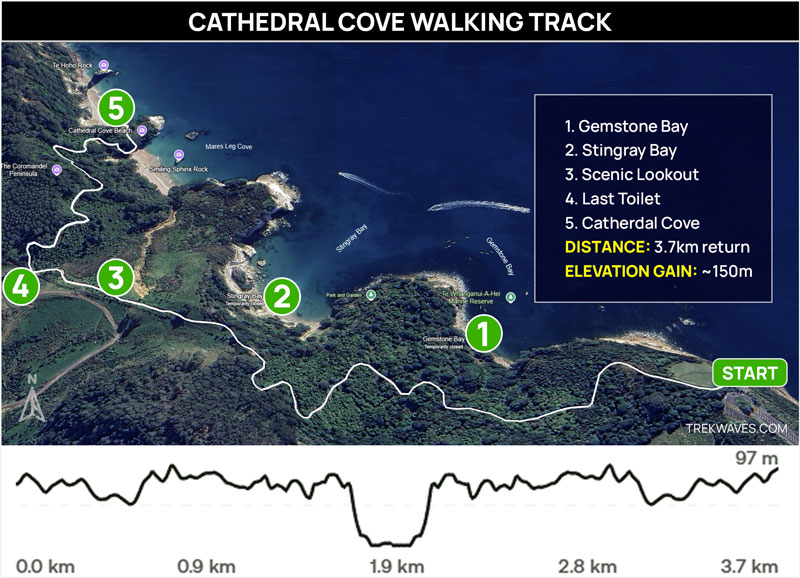
The Grange Road platform lookout at the start offers one of the best panoramic views of the whole trip.
On a clear day you can see all the way from Stingray Bay and Cathedral Cove in the foreground, past Motukorure and Moturoa Islands, out to the Mercury Islands and even the Aldermen Islands in the far distance — framed by the Coromandel ranges behind you.
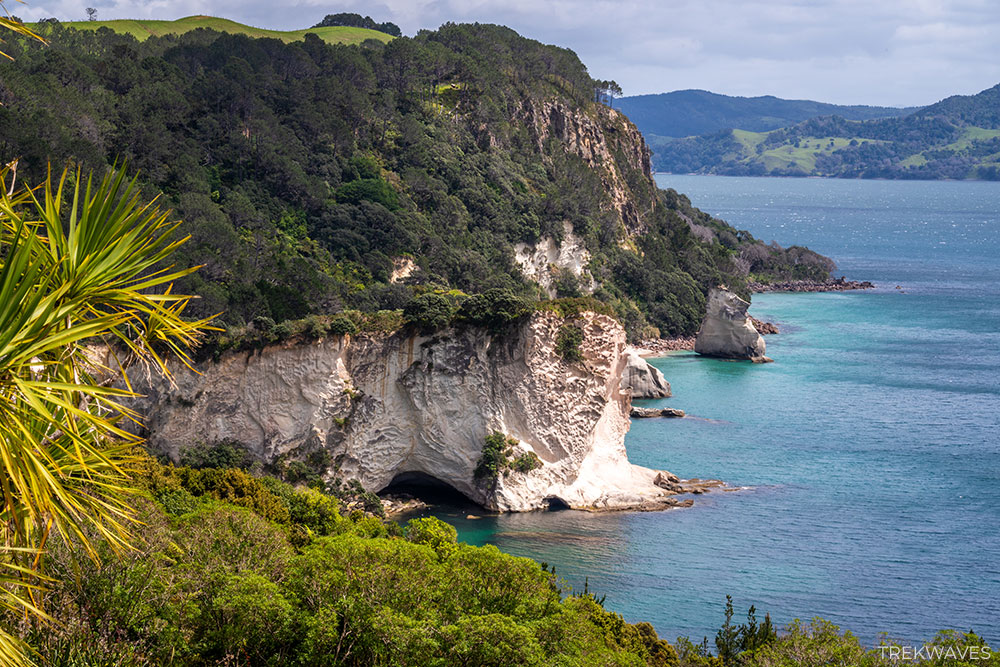
The track passes through a mix of native bush and open grassland, with pōhutukawa trees lining the coastal sections.
There are side tracks to additional bays along the way — worth the short detour if you have the time.
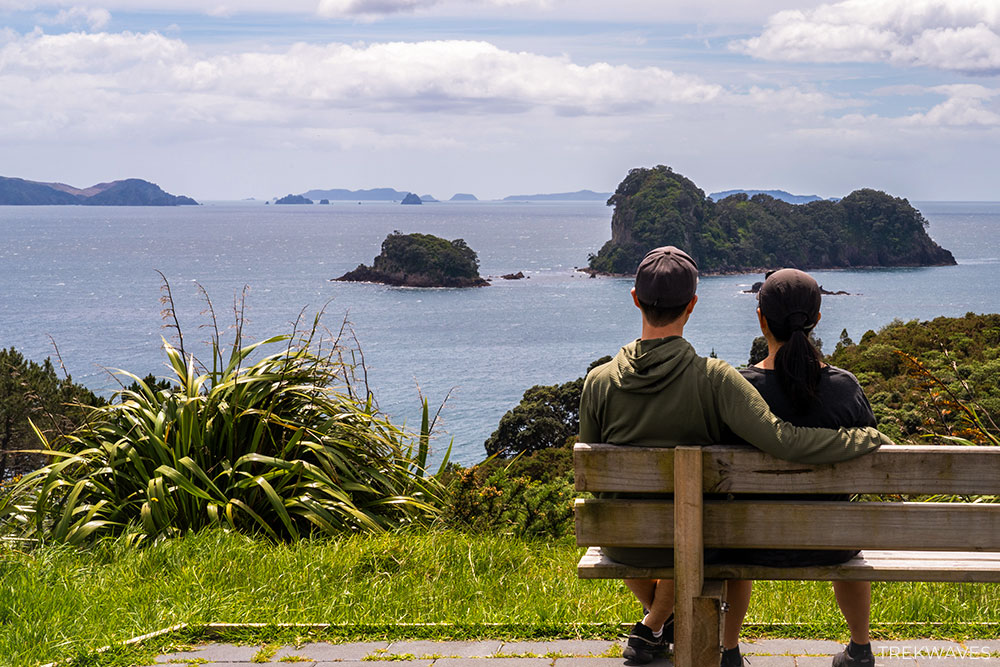
Overall, we found the track relatively easy and well within reach for most people with a basic level of fitness. The main challenge comes from the steady elevation changes, particularly on the way back, which can feel more noticeable on a hot day with limited shade in some sections.
If you’re planning to take the side tracks down to bays like Gemstone or Stingray, keep in mind these involve steep descents — and climbs back up — which add a bit more effort to the overall walk.
Cathedral Cove & Te Hoho Rock: Tides, Swimming & Geology
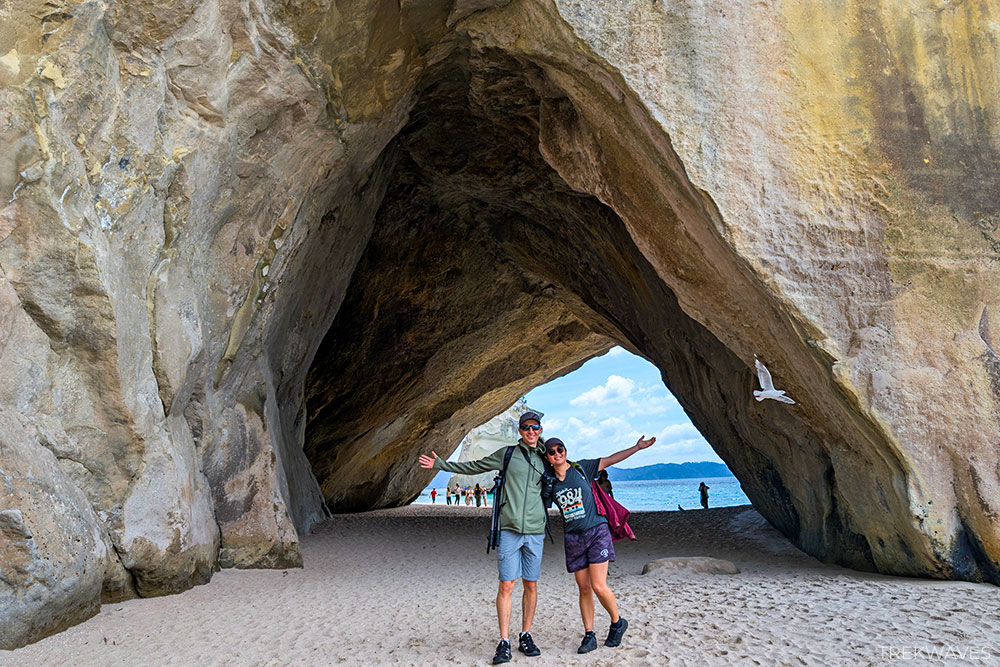
Nothing quite prepares you for the moment it finally reveals itself. After about 45 minutes on the track, the path drops down a final set of stairs — and as you step onto the sand, it suddenly opens up in front of you.
The arch is enormous, carved by centuries of wave action through a white cliff face, and the beach on the other side feels like a completely different world. It’s one of those spots that looks just as good in real life as it does in photos.
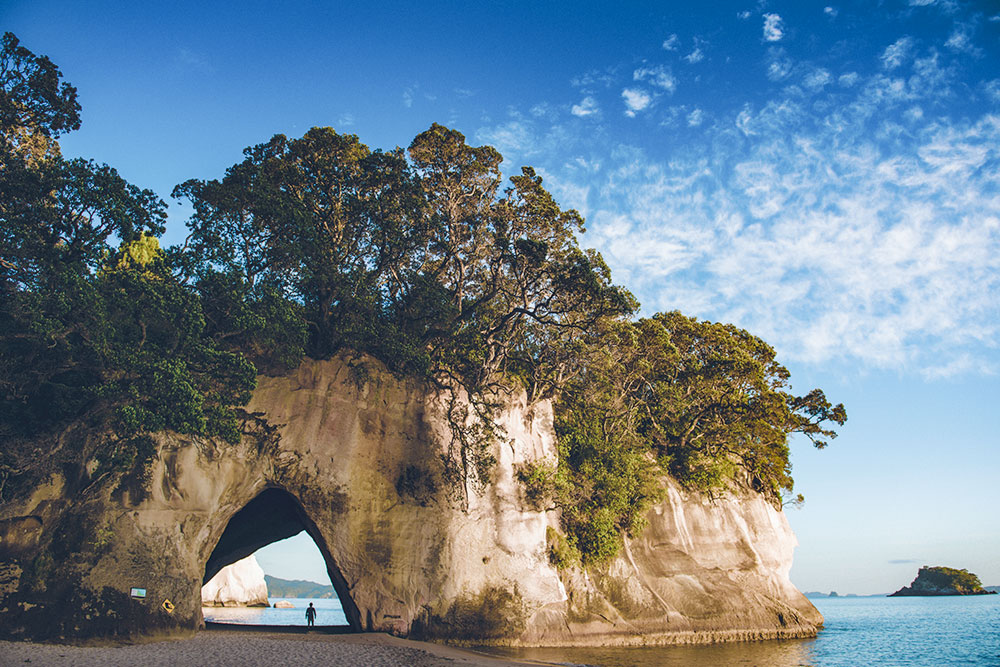
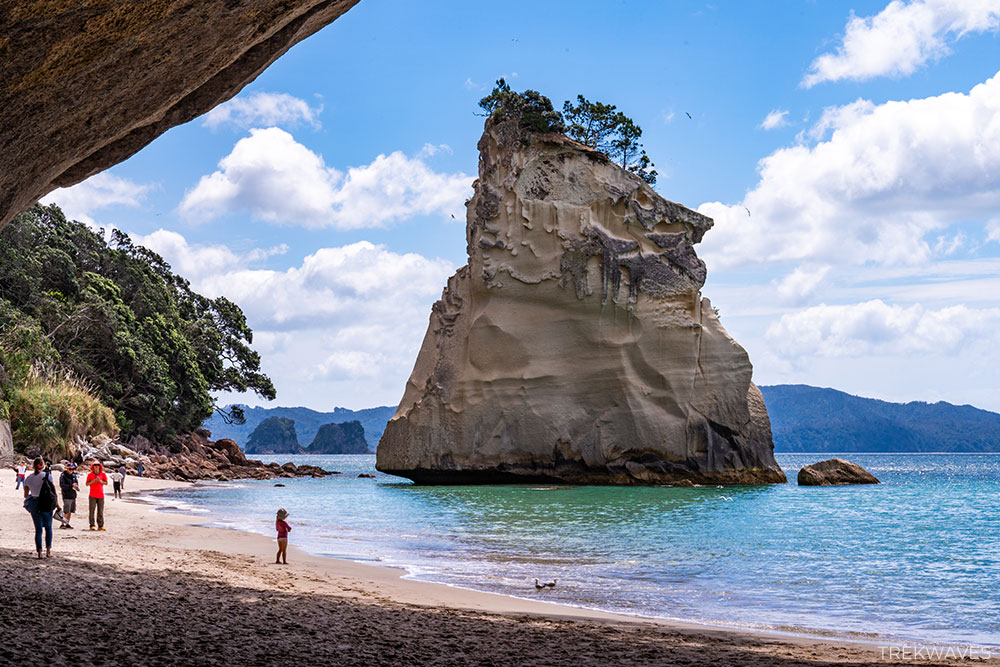
The geology here is fascinating. Although the Coromandel Peninsula is formed from some of the oldest sedimentary rocks in New Zealand — around 150 million years old — the coastline around Cathedral Cove was only formed about 8 million years ago from volcanic eruptions.
The white cliffs and the arch itself are made of ignimbrite — a mixture of volcanic ash and pumice — and it’s the relative softness of this rock that allowed wave erosion to carve out the arch and shape Te Hoho Rock over millennia.
That softer volcanic rock is a big part of why this coastline looks so dramatic compared to many other beaches on the Coromandel.
Tides at Cathedral Cove
The archway and parts of the beach can become impassable at higher tides or during big swells — and you don’t want to get cut off on the wrong side.
The sweet spot is mid to low tide: the arch is fully passable, the beach is at its widest, and the photography is at its best with water still in the frame. Always check the tide times before heading out — tideschart.com has a dedicated Cathedral Cove tide table.
Swimming at Cathedral Cove
Strong rip currents and big waves can make swimming dangerous, and there are no lifeguards here. The bay is also popular with boats, kayaks and jet skis that land directly on the beach — so the water is busy in peak season.
That said, on a calm day with the right tide, Cathedral Cove beach is a stunning spot for a swim. Just read the conditions carefully before getting in.
Snorkelling — Gemstone Bay & Stingray Bay
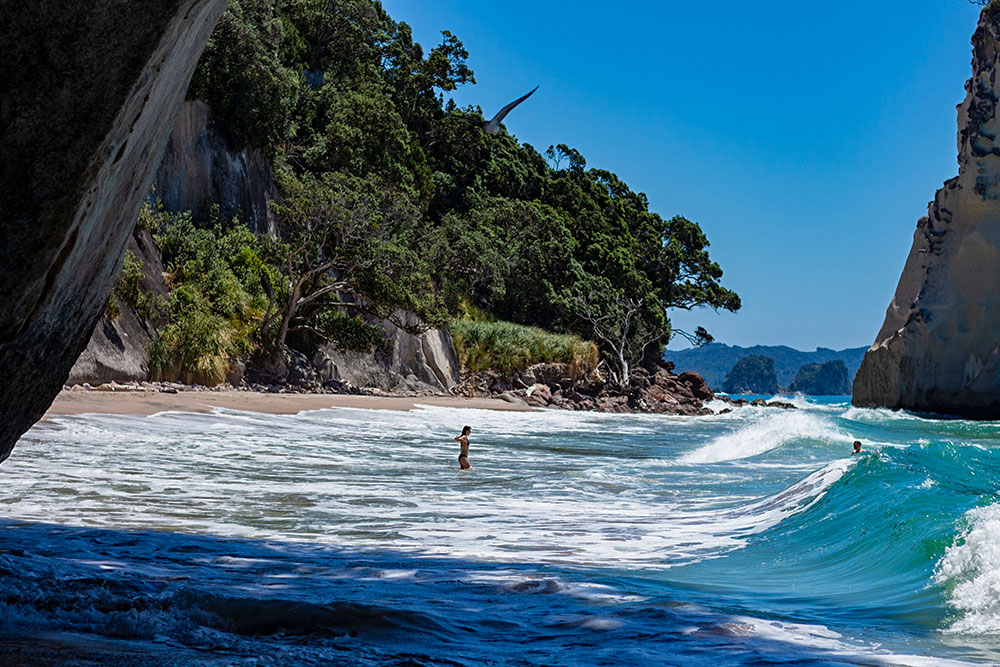
If you’ve got time (and the conditions are right), there are a couple of excellent snorkelling spots along the Cathedral Cove track — both located within the protected Te Whanganui-o-Hei Marine Reserve.
Gemstone Bay is the most popular and accessible option. It sits just off the main track and features a marked snorkel trail with floating buoys, making it easy to follow even if you’re new to snorkelling.
Just beyond it, Stingray Bay is a smaller and more sheltered spot, often known for sightings of rays during warmer months. It’s a quieter alternative, but access can be more limited depending on track conditions.
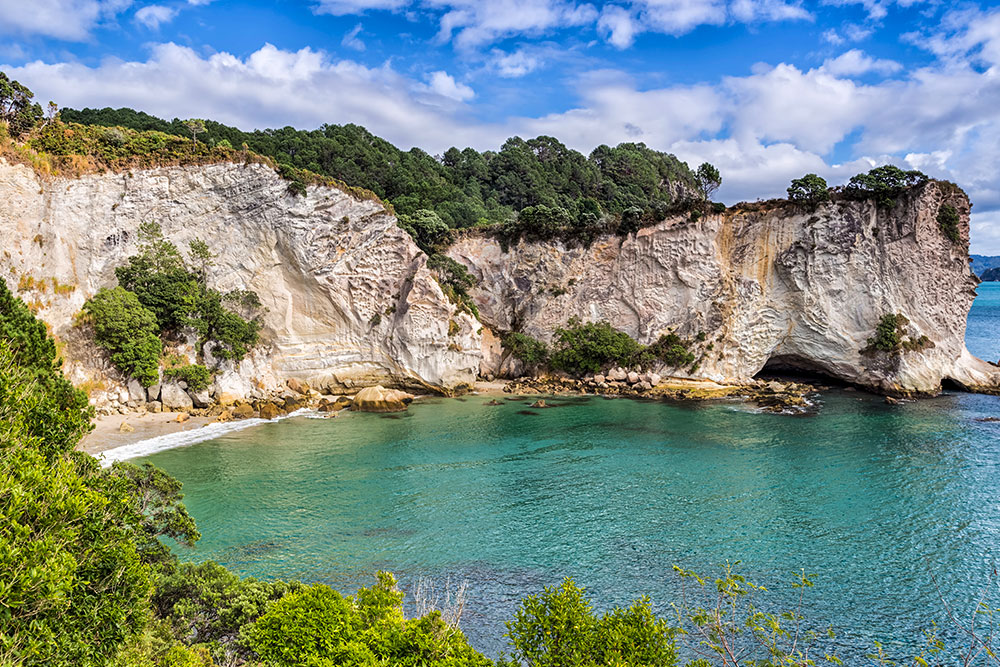
One thing to be aware of — access to these bays has been subject to track closures in recent years, and when we visited, both of these tracks were closed. It’s worth checking current conditions before heading out.
Tips for Making the Most of Cathedral Cove
- Tides — mid tide gives you the best access through the arch and the best photos with water in the frame. At high tide the arch can be partially or fully impassable
- No facilities on the beach — Cathedral Cove is a zero-waste site, so carry everything out with you
- Toilets are available at the Grange Road track start and near the Lees Road junction halfway down the track
- Rockfall is a genuine risk — the ignimbrite cliffs are unstable and actively eroding. Avoid sitting directly under cliff faces and follow any DOC signage on site
- Timing tip — we visited in early November and found it pleasantly quiet. Peak summer (December–January) is a different story — if you’re visiting then, an early morning start will make a noticeable difference to your experience
Final Thoughts: Is Hahei Worth Visiting?
Yes — Hahei is one of the best bases on the Coromandel for visiting Cathedral Cove and Hot Water Beach. Staying at least one night gives you time to beat the crowds, plan around the tides, and explore nearby spots like Cooks Beach, Shakespeare Cliff, and Gemstone Bay.
None of that happens when you’re simply ticking Hahei off a list and driving on.
If you’re exploring more of the North Island, Hahei fits in nicely alongside some of the region’s best coastal and volcanic walks. I’ve put together a full guide to the 25 Best Hikes in North New Zealand — worth checking out if you’re planning a bigger trip.
Found it Helpful? Pin it for Later!